$350 Million to Supercharge AI’s Power Problem: Redwood Materials’ New Raise
10/23/20251 min read
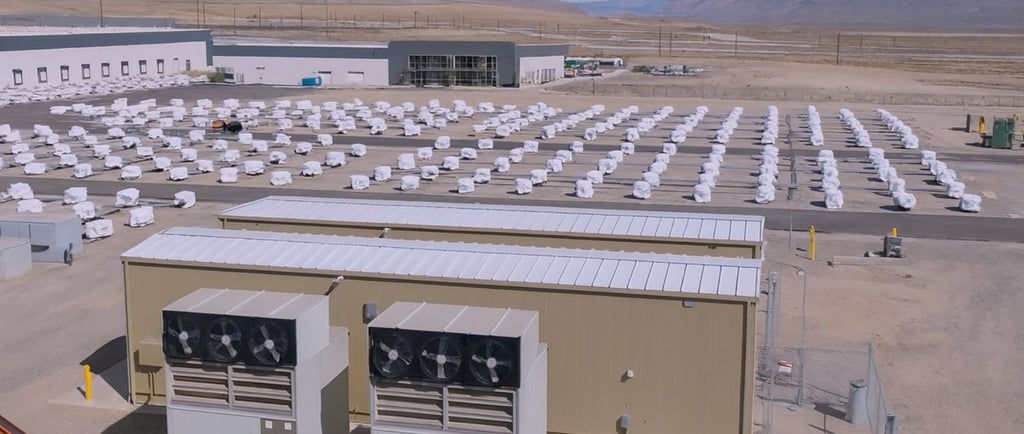
AI workloads are outpacing firm power additions. Grid-scale batteries are the fastest, often cheapest, way to add effective capacity near data centers. Redwood Materials’ $350 million injection is a direct bet that storage—not peaker plants—will keep training and inference online. Today’s reporting places Redwood’s valuation at ~$6+ billion, up from $5 billion after its 2023 mega-raise, reflecting investor conviction that cathode materials and stationary storage are now first-order AI infrastructure.
Redwood raised $350 million in fresh equity led by Eclipse, with Nvidia’s NVentures also participating. The Nevada-based company, founded in 2017 by Tesla cofounder JB Straubel, recycles critical inputs—lithium, cobalt, nickel, copper—manufactures cathode materials, and is scaling stationary energy storage systems for grid services and AI data centers. Proceeds will expand materials refining and cathode output, accelerate storage deployments, and add headcount. TechCrunch frames the raise squarely around powering the AI data-center buildout; Reuters highlights the strategic angle of securing domestic supply of critical materials alongside storage growth.
Grid operators are flagging multi-gigawatt shortfalls around hyperscale campuses; batteries can be sited and permitted faster than new generation and help meet 24/7 uptime targets when renewables are intermittent. Redwood’s vertical integration—recycling → refining → cathode → stationary storage—compresses timelines and hedges commodity risk. The company’s partner roster, including Volkswagen, Panasonic, Toyota and Lyft, reinforces both feedstock and downstream offtake as the U.S. races to localize battery supply chains supporting the AI boom.
Batteries are the new bandwidth. A $350M check and a ~$6B valuation signal that investors view storage and cathode supply as core to AI capacity planning, not an adjunct to chips. Expect more colocated storage at data-center clusters and tighter OEM loops to lock in metals and megawatt-hours at scale.